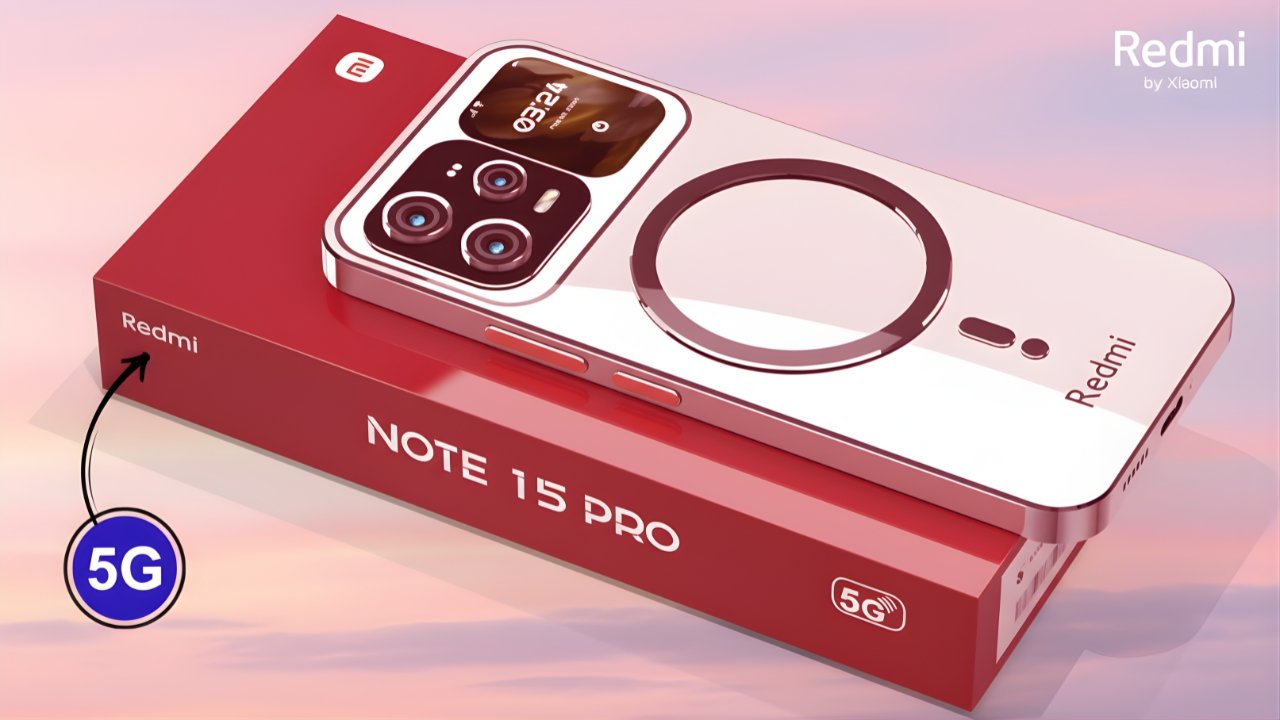
The Redmi Note 15 Pro arrives in a crowded value-flagship segment with an ambitious brief: deliver headline camera capability, very large battery life and tier-leading memory choices while keeping price competitive for mainstream buyers.
The new model is positioned to be a bridge between practical everyday phones and near-flagship powerhouses, targeting creators, heavy multitaskers and buyers who treat their phone as a primary computing and content device.
Early regional listings and launch previews show Xiaomi aiming for a broad global rollout and multiple regional SKUs to satisfy market differences in chipsets and battery/charging preferences; this means the Redmi Note 15 Pro will be judged both on its raw specification sheet and how well those specs are packaged into usable, long-term ownership value.
Design and Display
Xiaomi’s Note series has always balanced visual impact with everyday ergonomics and the Redmi Note 15 Pro continues that tradition with a large, sharply calibrated AMOLED display and modern curved or flat options depending on the market.
Leaks and retailer previews indicate a high-resolution 1.5K class panel on Pro models with 120Hz adaptive refresh and very high peak brightness for outdoor legibility, making the screen a highlight for streaming, gaming and editing on the move.
Build quality is pitched above typical mid-tier rivals: tighter panel gaps, refined chamfering and a choice of premium back finishes help the phone feel more expensive than its price suggests, while stereo speakers and careful acoustic tuning complete the multimedia experience. Practical details—IP splash/dust protection on higher trims, reinforced glass and replaceable lower cladding—are being emphasized in coverage to improve long-term ownership resilience.
Performance and Platform Choices
One of the most important real-world considerations with the Redmi Note 15 Pro is chipset and regional SKU choices: Xiaomi has used different silicon across markets in the Note series, and early coverage shows the Pro model may ship with MediaTek and Qualcomm variants depending on region, each tuned for a balance of performance and efficiency.
That strategy lets Xiaomi offer a compelling price/performance balance while adapting thermal solutions and tuning to the chosen SoC; reviewers point out that good sustained performance comes from a system approach—cooling, software scheduling and RAM/IO speed—not raw benchmark numbers alone.
Top RAM and storage configurations are notable: some reports and retailer pages mention high memory tiers and fast UFS storage that improve app resume and media handling, which means the Redmi Note 15 Pro is intended for users who keep many heavy apps and large media libraries on the device. For buyers this variety is a benefit, but it also means checking the exact SKU in your market is essential to get the performance profile you expect.
Camera System and Imaging Philosophy
Imaging is the marquee battleground for this generation of Note devices and the Redmi Note 15 Pro’s marketing spotlight naturally falls on the main camera package.
While some speculative pages and social posts have amplified claims of ultra-high megapixel counts, reputable launch pages and OEM spec sheets for the Note family show that the Pro models emphasise large sensors, improved OIS/EIS and computational pipelines rather than chasing raw megapixel numbers alone; a 200MP main sensor has been used in the Pro+ in some regions while the Pro often balances a high-resolution sensor with practical optics and stabilisation tuned for low light and motion.
That distinction matters: big sensor area and good optics combined with advanced image stacking and noise control typically produce more usable photos than sheer pixel count. Xiaomi has also continued to invest in video features—stabilisation, HDR capture and on-device editing—so the Redmi Note 15 Pro aims to be useful for everyday creators who want to shoot, edit and share from one device without moving to desktop tools.
Battery, Charging and Real-World Endurance
Battery life and charging are critical differentiators for buyers and Xiaomi’s Note roadmap shows a clear push toward very large cells in this series. Multiple regional spec pages list Pro models with 6,500–7,000mAh class batteries and faster wired charging options than previous generations; real-world testing after launch will be the true arbiter, but early coverage from retail and launch pages underscores a practical focus—long single-charge life for commuters and very fast top-ups for heavy users.
It’s sensible to expect the Redmi Note 15 Pro to include intelligent battery management—adaptive refresh controls, intelligent background throttling and charging modes that protect long-term capacity—because superfast charging without battery-care strategies can degrade long-term retention.
For owners, the combination of a large cell and fast replenishment reduces friction: shorter plug-in times and multi-day practical endurance for moderate use are the end goals.
Software, Connectivity and Special Features
Software and feature polish often separate good hardware from great user experiences, and the Redmi Note 15 Pro ships with Xiaomi’s HyperOS layer which continues to add creative tools, performance modes and system-level battery management.
Connectivity is comprehensive: dual-SIM 5G on supported bands, Wi-Fi 6/6E on higher SKUs, NFC where regional payments require it and full stereo audio and location capabilities for creators and travellers.
Value additions include over-the-air updates, cloud sync tools and expanded camera modes for creators; importantly, Xiaomi’s service and update commitments in your local market should be checked because promised software longevity and update cadence are a part of the long-term ownership value proposition.
For enterprise or heavy-use customers, the availability of higher RAM tiers and faster storage variants may be decisive.
Ownership, Pricing Strategy and Market Position
Xiaomi’s pricing approach historically positions the Note series to undercut premium rivals while providing many of the same headline features; early regional pricing hints suggest the Redmi Note 15 Pro will be priced competitively to capture volume in price-sensitive markets while offering optional higher-end SKUs for enthusiasts.
Ownership considerations centre on aftersales support, parts availability and the exact in-box accessories—fast chargers for rapid top-ups, protective cases and warranty terms.
Resale and long-term value will be influenced by Xiaomi’s local service ecosystem and the phone’s perceived software longevity; buyers should confirm the exact model and warranty bundle at purchase because small differences in regional SKUs (chipset, charging wattage, storage tiers) can have a large impact on day-to-day experience and long-term value.
Overall, the Redmi Note 15 Pro aims to offer a compelling balance of advanced features and pragmatic ownership costs for mainstream buyers and power users alike.
Conclusion
The Redmi Note 15 Pro is a strategic device for Xiaomi: it attempts to combine the headline thrills of big sensors, large batteries and high memory options with the pragmatic engineering required for real-world ownership.
For buyers the decision will hinge on three practical checks: confirm your market’s exact SKU (chipset, memory, battery and charging), test the camera and display in the lighting and apps you use most, and verify local warranty and service options to protect long-term value.
If Xiaomi’s execution matches the specification ambition, the Redmi Note 15 Pro will deliver heavyweight daily performance and impressive battery convenience without a flagship price premium, making it an attractive choice for creators, multitaskers and value-focused upgrade buyers.
Disclaimer:
this article synthesises official launch pages, reputable regional coverage and retail previews to offer an informed perspective; confirm final specifications, in-box accessories, pricing and warranty details for the Redmi Note 15 Pro with Xiaomi or authorised retailers in your market before purchasing.
