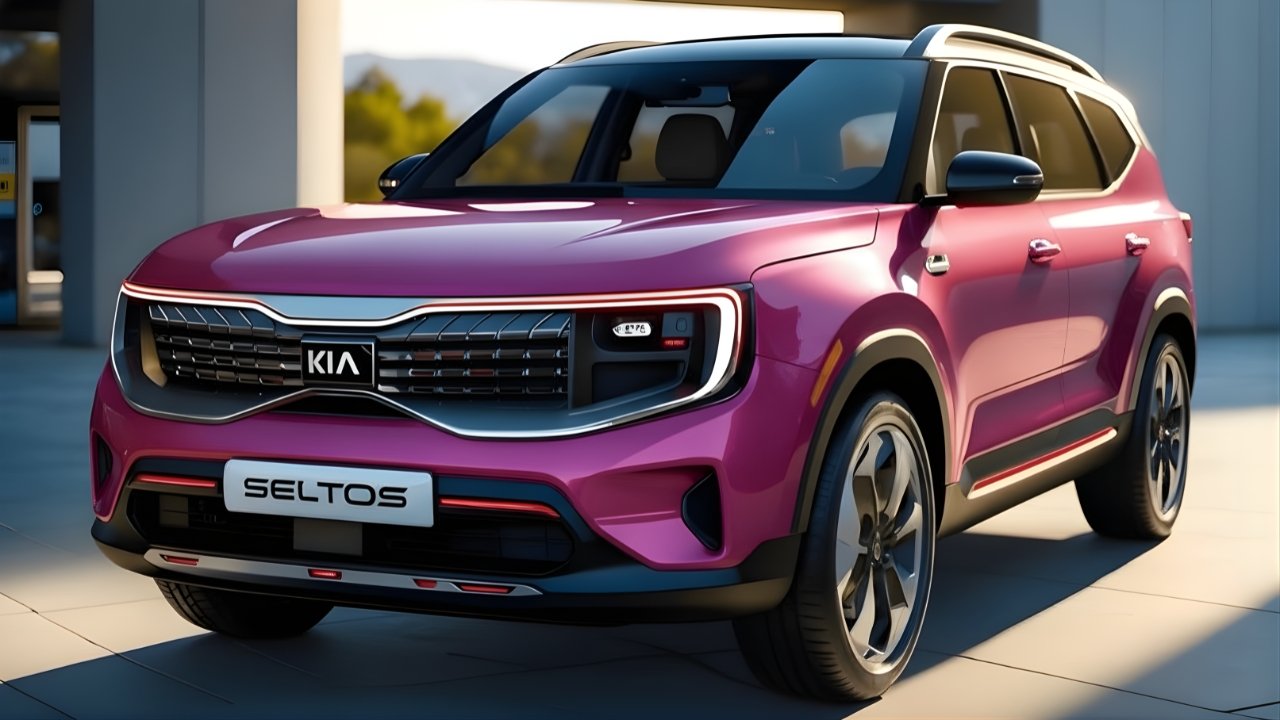
The Kia Seltos 2026 arrives as a strategic next step for Kia in the compact-SUV segment, blending sharper design, clearer trim differentiation and a stronger focus on cabin quality so it can compete with premium rivals while remaining value-aware.
The Kia Seltos 2026 refreshed model aims to deliver meaningful improvements in driving feel, technology and perceived quality rather than a shallow cosmetics-only update, and the result is an SUV that seeks to appeal both to existing Seltos buyers and to customers stepping up from smaller hatchbacks.
Throughout development Kia Seltos 2026 engineers focussed on preserving the Seltos’ practical virtues—roomy passenger space, easy ingress and sensible cargo capacity—while tightening the chassis, improving NVH and offering new powertrain calibrations that cater to buyers who want a little extra pep without sacrificing fuel efficiency.
Design and Exterior
The new Kia Seltos 2026 design language blends family identity with contemporary detailing: sharper LED signatures, a more tightly integrated grille and sculpted flanks give the car a muscular, contemporary stance without inflating visual mass.
Designers worked to make the front and rear treatments look cohesive under motion—active aero elements are subtle and mostly invisible at low speeds but contribute to stability at higher velocities—so buyers get the benefit of improved highway manners alongside attractive, modern styling.
Practical exterior elements were not lost in the styling exercise: replaceable lower cladding, easily serviced lighting modules and roof-rail load ratings that support genuine rooftop cargo or racks reflect Kia’s intention that the model be used, not just admired.
The Kia Seltos 2026 revised colour palette and wheel options aim to broaden appeal: restrained tones and two-tone finish choices allow buyers to personalise without drifting into polarising extremes, and fitted mudguards and stone-chip resistant lower panels reduce the cost and frequency of day-to-day repairs for owners who use the car in mixed conditions.
Powertrain and Efficiency
Kia Seltos 2026 reworked the powertrain matrix to offer clearer choices for different buyer priorities: economical naturally aspirated petrols for urban commuting, a refined turbocharged option for those who prioritise mid-range torque and a mild-hybrid assist that improves low-speed responsiveness and reduces stop–start consumption.
The turbocharged variant benefits from improved thermal management—larger charge-air cooling, enhanced oil cooling and recalibrated shift logic—so the engine feels stronger and more consistent under load with fewer episodes of heat-related derating.
For markets that prioritise low running cost, the updated CVT and refined manuals include new gear or ratio mapping to keep engine speeds down on motorways and improve real-world fuel numbers. Kia’s engineers also calibrated the drivetrains to work smoothly with the chassis changes: throttle maps are more progressive to suit the Seltos’ increased grip and the interplay between engine and transmission reduces abrupt torque spikes, producing a more composed and predictable driving experience across speeds.
Chassis, Handling and Ride Comfort
The Kia Seltos 2026 updated suspension geometry and added structural stiffening change the Seltos’ road manners in a purposeful way: the steering has a more decisive on-centre feel, body roll is better controlled through mid-corner transitions and ride compliance is tuned to neutralise the worst of urban imperfections.
Engineers Kia Seltos 2026 added selective bracing in key load paths to improve front-end rigidity, which sharpens turn-in and allows tyre contact to be maintained more consistently on uneven surfaces. Dampers were retuned with new valving profiles and the optional adaptive damping system (where offered) spans from comfortable highway cruising to firm, composed sport settings for more dynamic driving.
Noise, vibration and harshness (NVH) improvements were comprehensive: thicker glass, additional bulkhead insulation and tuned underbody acoustic foams reduce wind and tyre noise at speed, transforming long journeys into more relaxed affairs and letting the audio system perform closer to its intended fidelity.
Interior, Materials and Practicality
Inside the cabin the Kia Seltos 2026 advances the prior model’s strengths with improved surface finishes, better ergonomics and storage solutions that make day-to-day life easier. High-contact areas feature softer surfaces and better stitching quality, while durable, easy-clean materials remain where owners expect them—seat bolsters, door pockets and centre-console tops—so the car resists wear in family or active lifestyles.
Seat Kia Seltos 2026 geometry was updated to provide longer support without being overly bolstered, allowing comfortable long-distance seating for a wide range of body types; rear-seat occupants benefit from improved legroom packaging and a flatter floor in certain trims for genuine three-across comfort on short trips. Practical storage is enhanced by a reworked centre console, deeper door bins and modular cargo tie-downs that allow flexible luggage organisation without compromising the available boot volume.
Thoughtful touches—USB-C ports in all seating rows, wireless charging pads with improved ventilation, and improved acoustic parcel-shelf attachments—speak to a buyer who values convenience and thoughtful engineering rather than gimmicks.
Technology, Connectivity and Driver Assistance
Kia Seltos 2026 tightened the technology offering with a clearer UX, faster infotainment processors and improved connectivity options that include over-the-air updates for navigation and crucial vehicle firmware. The instrument cluster is configurable and presents driver-important data—trip economy, torque usage and ADAS status—prominently when the driver needs it while receding into a calmer presentation for everyday driving.
Driver assistance systems were recalibrated for smoother interventions: adaptive cruise with better low-speed follow, lane-keeping that provides gentle corrections rather than abrupt steering nudges, and a more intuitive blind-spot monitor that accounts for trailer or rooftop attachments when fitted.
Importantly, Kia invested in making these systems feel like helpers rather than replacements for driver attention—settings allow owners to tune intervention severity and reactivity so the systems match personal taste and the typical driving environment.
Safety, Testing and Real-World Performance
Safety engineering for the Kia Seltos 2026 focused on expanding passive protection while ensuring that active systems are effective without being intrusive. The cell was reinforced in key areas to better manage crash energy and reduce intrusion, and airbag coverage was reviewed to protect occupants across a wider range of impact scenarios.
Electronic stability systems now integrate more tightly with traction control and adaptive dampers so the vehicle can stabilise itself earlier and more gently when grip is lost, which reduces the chance of high-energy corrections. On-road testing shows the Seltos to be predictable and confidence-inspiring, with steady braking distances and a composed chassis that rewards sensible inputs rather than dramatic steering corrections.
Real-world economy is competitive for the class when spec’d with the mild-hybrid or the refined gasoline mill, and cooling and thermal upgrades mean owners who tow small trailers or carry sustained loads will find the car to be more durable under stress than earlier iterations.
Ownership, Cost of Running and Conclusion
Kia’s ownership proposition for this generation is pragmatic: clear service intervals, accessible service points and an expanded network of certified parts mean downtime and repair costs remain predictable, and warranty and roadside programmes are positioned to reduce total cost of ownership for the first five years.
Residual values should benefit from the Seltos’ broadened appeal and improved material quality, particularly in markets where compact SUVs are highly sought after and well-supported dealer networks help preserve maintenance history and certification.
For prospective buyers the best approach is straightforward—test the turbo and mild-hybrid variants in representative traffic, try higher spec trims to sample the NVH and tech improvements, and review dealer servicing options and bundled maintenance plans to understand running cost implications.
In sum, the Kia Seltos 2026 is a carefully revised compact SUV that tightens driving dynamics, raises perceived cabin quality and modernises technology while keeping ownership sensible and predictable for families and urban buyers alike.
Disclaimer:
This article is informational and based on likely feature sets, engineering directions and early product briefings; readers should verify official Kia specifications, trim content, pricing and regional availability with authorised dealers before making a purchase decision.
