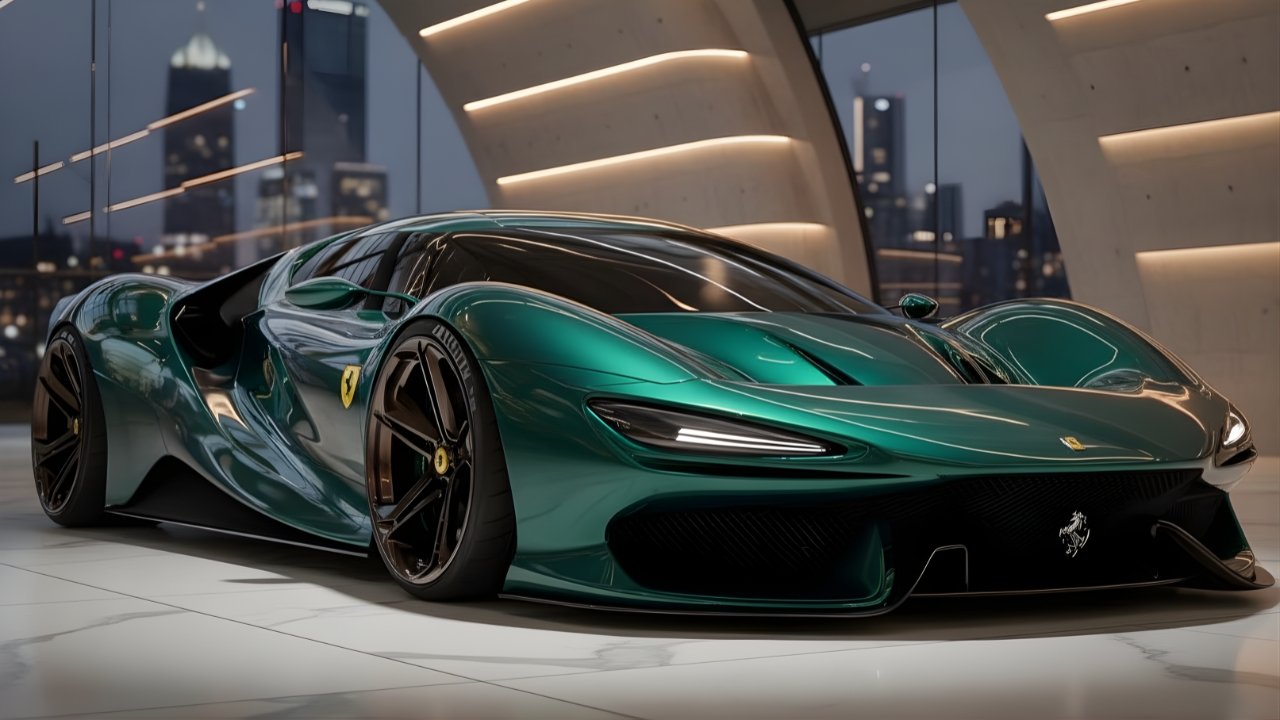
The Ferrari F80 arrives as the marque’s vision of a future flagship hypercar, and the Ferrari F80 is presented as a statement machine that combines extreme performance with refined usability for collectors who demand both pace and presence.
Designers framed the Ferrari F80 as an integrated exercise in aerodynamics, materials science and sensory drama, because a modern flagship must be measured not only by outright lap times but by how it communicates intent to a driver at speed.
Early previews suggest the Ferrari F80 will fuse a dramatic silhouette with rigorous engineering choices—every panel, vent and structural element contributes to performance while keeping the car emotionally immediate.
Design and Aerodynamics
Exterior sculpture on the Ferrari F80 is deliberately theatrical yet meticulously functional; the series of channeled surfaces and active aero elements work together to generate downforce, manage cooling and stabilise yaw at extreme speeds.
The Ferrari F80’s open and closed configurations are both considered from the start: roof integration, roll-over loads and wind management were engineered so that the car remains composed when the top is retracted.
The split-flow diffuser, adjustable front splitter and rear wing are coordinated by predictive controls that alter the car’s aerodynamic balance based on speed, steering angle and lateral load, ensuring that the Ferrari F80 delivers both high-speed confidence and predictable behaviour on technical circuits.
Powertrain and Performance
Powertrain architecture is central to the Ferrari F80’s character: a high-revving combustion heart augmented by intelligent electric assist delivers instantaneous throttle response and repeatable performance under sustained load.
The hybrid systems in the Ferrari F80 are tuned for torque fill rather than economy-first behaviour, giving the driver immediate thrust out of corners while allowing the internal combustion engine to operate in its optimal thermal band at highway speeds.
Engineers emphasised thermal robustness—scaled intercoolers, redundant oiling pathways and dedicated gearbox cooling—so the Ferrari F80 maintains peak performance across multiple laps or long high-speed runs without progressive derating. Transmission and final-drive hardware were uprated for extreme use, delivering razor-fast shifts and crisp mechanical feedback that match the car’s violent capability.
Chassis, Handling and Dynamics
Beneath the alloy and carbon surfaces the Ferrari F80 employs a highly stressed carbonfibre structure with engineered load paths to maximise stiffness while trimming mass where it matters.
Suspension geometry uses multi-link layouts with adaptive dampers and optional active roll-control to keep the tyre contact patch honest across dynamic transitions; the result is a car that reacts with immediacy yet remains controllable when the pace escalates.
Electronic torque vectoring, braking-by-wire and selectable stability maps are calibrated to expand the car’s usable limit without removing driver agency, and track-focused setups allow experienced drivers to exploit the Ferrari F80’s handling precision while keeping safety nets available for less practiced pilots.
Interior, Craftsmanship and Usability
The cockpit of the Ferrari F80 is driver-centric and intentionally tactile: primary controls sit within effortless reach, high-contrast displays present only the essential telemetry in performance modes and premium materials are chosen for both feel and long-term durability.
Comfort is balanced with control—seats are sculpted for lateral support on circuit days but include adjustment and climate functions that make the Ferrari F80 tolerable for long-distance journeys. Storage is minimal by design but pragmatic in execution, with secure compartments for essentials and a cabin layout that keeps attention on driving.
Acoustic tuning is sophisticated so that the car’s mechanical soundtrack is present yet not fatiguing, preserving the sensory relationship between driver and drivetrain.
Technology, Safety and Connectivity
Advanced driver aids on the Ferrari F80 are implemented to reduce cognitive load and to improve repeatability on track: predictive traction control, adaptive torque splits and telemetry logging enable owners to review performance and refine technique.
Over-the-air updates and modular software allow Ferrari to refine drive maps and navigation functionality over time, while vehicle health monitoring gives predictive alerts for thermal, lubrication and brake system wear.
Passive safety and structural engineering were integrated from the outset so that the Ferrari F80 meets rigorous crash standards without compromising the car’s lightweight philosophy; owners benefit from a car that is both extreme and sensibly engineered.
Market Positioning, Ownership and Conclusion
Positioned at the pinnacle of Ferrari’s road-going portfolio, the Ferrari F80 is marketed as a limited-production flagship for collectors who expect exclusivity, factory-backed performance training and robust service support.
Commissioning programmes, bespoke finishing options and structured owner events are part of the ownership proposition so buyers can extract maximum value and enjoyment from the car. The Ferrari F80 therefore represents not only a technical achievement but also a curated ownership journey that includes factory tuition and tailored maintenance plans.
Prospective buyers should prioritise factory demonstration runs, review thermal and service packages, and consider long-term storage and maintenance plans to protect residual value. In short, the Ferrari F80 is designed to push Ferrari into a new dimension of speed while remaining an engineered, supported and emotionally rewarding hypercar.
Disclaimer:
This article is informational and reflects analysis and likely engineering directions; readers should verify official Ferrari specifications, pricing and availability with authorized dealers before making purchase decisions.
