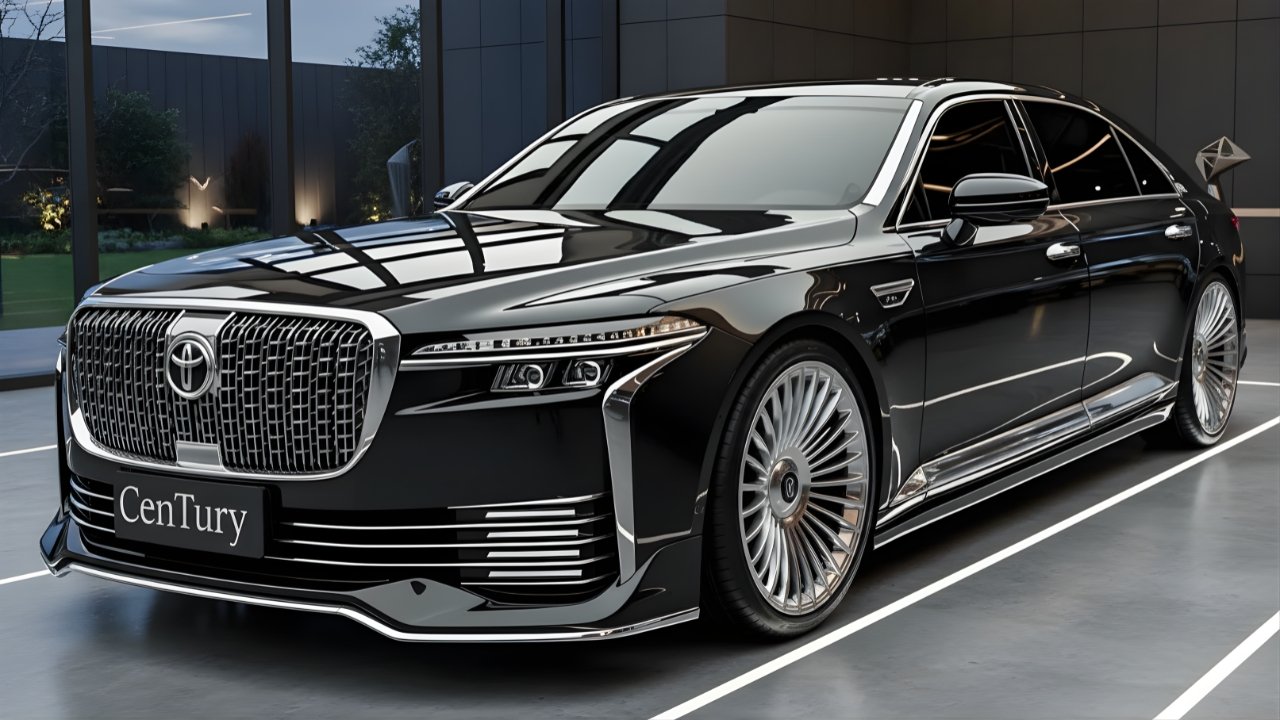
The return of an emblematic Japanese flagship is more than product news; it is a statement about brand intent and national automotive craft. The Toyota Century 2026 represents Toyota’s conscious decision to codify the Century name as the company’s top-of-the-top product family, prioritising quiet luxury, discreet presence and an ownership experience built on ceremony as much as engineering.
Where many modern luxury cars shout with styling and tech adverts, the Toyota Century 2026 instead emphasises weighty materials, measured proportions and integrated systems that make long journeys restful and dignified.
Toyota has used the Century line historically for government, corporate and ceremonial transport and the contemporary program expands that role while respecting the model’s traditional cues; this continuity means the Toyota Century 2026 must be judged by standards of refinement and long-term value rather than mere headline performance.
Design and Exterior
Design for the Toyota Century 2026 continues the brand’s long habit of quiet confidence: a formal stance, long bonnet and restrained greenhouse give the car an unmistakable profile without resorting to ostentation. Surface detailing is deliberate rather than decorative; vents, creases and lighting elements are shaped to serve aero, cooling and visual depth.
The Century programme also embraces a degree of bespoke craftsmanship—panel fits, specialty paint processes and unique badging convey the hand-finished character expected at this level. On the SUV variant and recent Century releases Toyota has shown a willingness to reinterpret the nameplate across body styles while preserving the ethos of dignified space for rear passengers; this means that the Toyota Century 2026’s exterior language is as much about signalling back-seat hospitality as it is about front-wheel theatrics, and finished examples are likely to wear subdued colour palettes and premium wheel finishes that complement the vehicle’s measured presence.
Powertrain and Performance
Under the skin, the Toyota Century 2026 is aligned with Toyota’s multi-pathway powertrain strategy: expect hybrid emphasis for the combination of refinement, low-frequency torque delivery and lower in-service emissions that suit the car’s role as chauffeur-oriented transport.
Toyota’s recent Century SUV and earlier sedan models have shown plug-in hybrid and refined V8 hybrid options; for 2026 the brand is expected to continue hybridisation while optimising for smoothness, low NVH and repeatable long-distance performance. Thermal and cooling systems are scaled to avoid heat soak in stop-start urban scenarios and sustained high-load conditions, because a luxury flagship must feel as composed after several hours on the road as it does on a short journey.
Power delivery is therefore tuned for linearity and quiet refinement rather than aggressive peak power, and transmission calibrations aim to keep engine speeds low at cruising while offering instant, dignified acceleration when demanded.
Interior and Craftsmanship
The interior of the Toyota Century 2026 is where the model’s philosophy becomes tangible: materials selected for both tactile pleasure and longevity, seats formed to provide supportive repose for long journeys, and acoustic insulation engineered to create a sanctuary from traffic and urban noise.
The Century tradition places an emphasis on rear-seat comfort and hospitality; expansive rear legroom, power reclining seats, and carefully controlled cabin climate deliver the sort of calm one expects in a car used for official duties and executive travel. Craftsmanship is visible in hand-stitched leather, metalwork with refined finishes, and wood or bespoke woven trims that reference Japanese artisanal traditions without being literal museum pieces.
Storage and usability are considered too—subtle stowage, well-placed ports and connectivity that does not intrude on the cabin’s quiet are all executed to a standard that favors usability over gadgetry. In short, the Toyota Century 2026 aims to be a quietly opulent mobile living room where the engineering serves the ambience rather than dominates it.
Technology and Safety
Technology in the Toyota Century 2026 is applied with restraint and purpose: advanced driver assistance systems protect occupants and reduce fatigue on long drives, while telematics and over-the-air capability maintain navigation, infotainment and system calibrations with minimal dealer visits.
Safety is intrinsic—modern occupant cells, multi-stage airbags and stability systems are blended with driver-assistance that can be dialled to be unobtrusive for experienced chauffeurs but protective for regular use. For owners who require privacy and security there are also likely to be bespoke systems—window dimming, advanced glazing and discreet alarm/geo-fencing—that reflect the vehicle’s role in ceremonial and executive contexts.
Importantly for a flagship that may be used extensively in formal processions, Toyota engineers prioritise system reliability and serviceability so that advanced technology does not become a source of unexpected downtime.
Market Positioning and Ownership
Toyota has repositioned Century above Lexus in the corporate hierarchy, signalling that the Toyota Century 2026 is intended to be both a prestige symbol and a platform for bespoke, limited production models. That strategy lets Lexus explore new directions while the Century focuses on measured luxury, family heritage and special-occasion gravitas.
Ownership expectations for such a car are correspondingly bespoke: buyers anticipate factory commissioning, extended support, curated service plans and opportunities for highly personalised finishes that preserve uniqueness and residual value.
Toyota’s limited production approach and careful parts support aim to maintain long-term desirability; this is a car bought as much for its continuity and cultural capital as for its day-to-day utility, and the manufacturer’s dealer and service network is prepared to provide a concierge-level relationship to owners who expect that level of attention. Prospective buyers should therefore evaluate regional support, commissioning timelines and post-delivery services as part of the acquisition decision.
Conclusion
The Toyota Century 2026 is a statement of restrained luxury and continuity: it is less about aggressive marketing and more about preserving a carefully curated experience for owners who value heritage, craftsmanship and usable refinement. By concentrating on hybridised refinement, meticulous acoustic engineering and a cabin that reads like a private salon, Toyota positions the Century as a modern answer to ceremonial and executive mobility without sacrificing the brand’s focus on reliability and serviceability.
For buyers and enthusiasts the right approach is to experience the car in real conditions—ride in the rear with representative luggage and occupants, evaluate how the powertrain copes with motorway climbs and city micro-traffic, and review commissioning options to ensure the finished vehicle aligns with personal expectations. The Toyota Century 2026 will appeal to those who prefer understated excellence over spectacle, and for that audience the car promises to uphold a quietly distinctive standard.
Disclaimer:
This article summarises Toyota’s Century programme and recent reporting; verify exact specifications, features, pricing and availability with official Toyota communications or authorised dealers before making purchase decisions.
