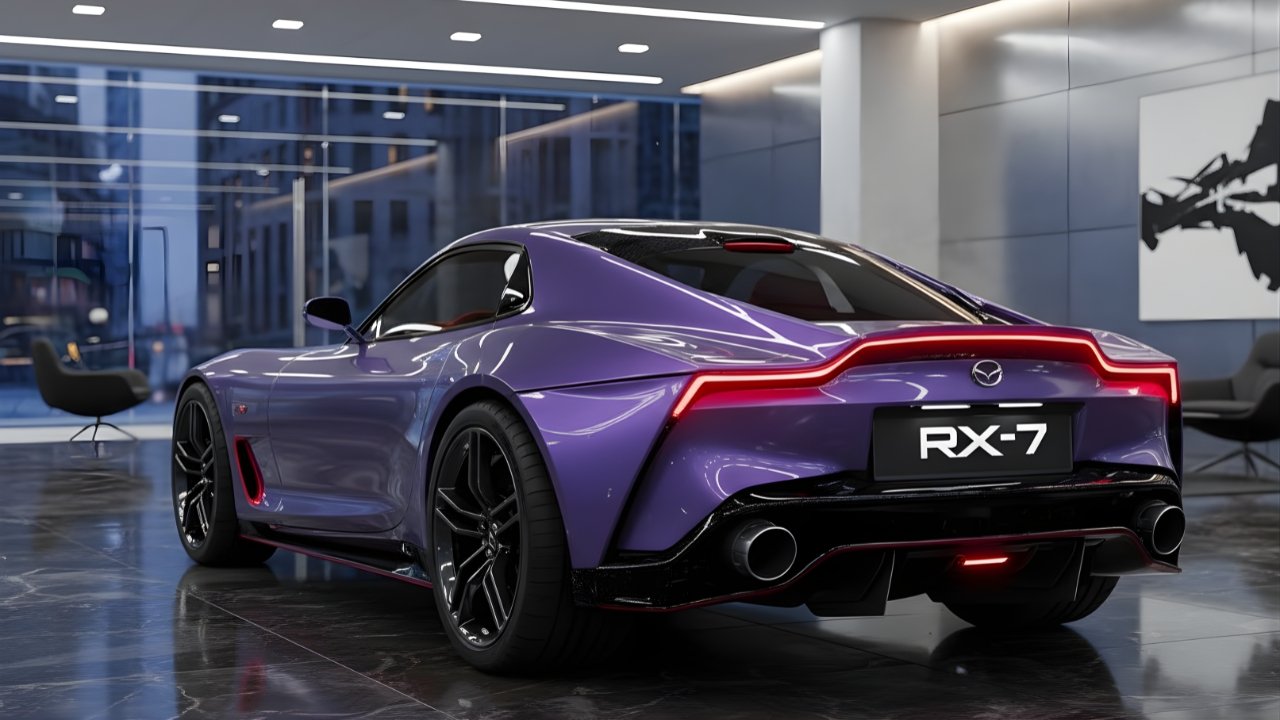
The automotive world has long held a soft spot for icons that disappear and then return transformed, and the 2026 Mazda RX 7 arrives as one of those culturally significant comebacks that blends memory and modernity.
The 2026 Mazda RX 7 is presented not as a simple retro revival but as a thoughtful re-interpretation: rotary heritage married to hybrid assistance, lightweight dynamics and a chassis tuned for both road and track. Mazda’s mission with this model was clear from the outset—capture the emotional immediacy of the original RX-7 while resolving the environmental, packaging and refinement compromises that would have made a direct revival impractical.
The result is a machine that aims to satisfy purists who crave the rotor’s unique voice and torque delivery, as well as new buyers who want advanced electronics, credible crash protection and a cabin that works for everyday life.
Design and Exterior
Visually the 2026 Mazda RX 7 aims to walk a careful line between homage and forward design language: proportions are compact and low, with a long bonnet, short overhangs and a roofline that sweeps into a purposeful rear haunch.
The surfacing pays subtle tribute to classic RX motifs—muscular flanks and a sense of restrained aggression—while using contemporary cues such as flush door handles, slim matrix LED headlights and integrated aerodynamic devices to control lift and cooling. Attention to aerodynamic balance is obvious: a discrete front splitter, vented bonnet outlets, sculpted undertrays and an active rear element collaborate to stabilise the car at speed without resorting to ostentatious wings.
Panel gaps are tight, and structural elements beneath the skin are optimised for torsional stiffness to reduce the need for heavy reinforcement; this keeps the 2026 Mazda RX 7 lithe and responsive while preserving a tidy visual footprint that is at once athletic and elegant.
Powertrain and Hybrid Strategy
The 2026 Mazda RX 7’s most headline-grabbing element is its engine architecture: a compact rotary core paired with a multi-mode hybrid assist system that elevates real-world performance and efficiency without blotting out the engine’s character.
The rotary receives modern engineering—advanced sealing materials, variable porting strategies and a carefully managed thermal environment—so that the 2026 Mazda RX 7 can deliver the smooth, high-revving personality fans expect while addressing longevity concerns that plagued earlier rotaries.
Electric assistance is tuned primarily for torque fill and regenerative capture: brief bursts of instant electric torque help mask low-end thinness, making the car feel punchier from off the line and more tractable in urban traffic, while a small but high-power battery allows for silent, short-range manoeuvring at low speeds.
The transmission is a rapid dual-clutch unit with close ratios and a mechanical feel, chosen to keep the driver connected to the engine’s voice and to allow the 2026 Mazda RX 7 to exploit the rotary’s broad powerband on track.
Thermal management—improved intercooling, dedicated oil circuits and a robust cooling pack—was scaled to permit repeatable hot-lap performance without derating, an imperative for an enthusiast car that is intended to be driven.
Chassis, Handling and Dynamics
The chassis philosophy for the 2026 Mazda RX 7 emphasises low polar inertia, precise steering and controllable balance so the car rewards skilled inputs rather than covering them in electronic intervention. A mixed-material monocoque blends aluminium and selectively used high-strength steels with carbon-fibre reinforcements in key load paths to keep mass concentrated centrally and to lower unsprung weight where possible.
Suspension geometry uses lightweight double-wishbones at the front and a sophisticated multilink assembly at the rear, with adaptive dampers that offer a broad spread between compliant touring settings and firm, track-oriented modes.
Engineers calibrated progressive bump and rebound tuning so the car remains composed over midcorner imperfections yet gives clear feedback at the tyre contact patch; steering is hydraulically assisted with an electrically variable assist function to deliver natural weight and crisp feedback without the numbness common to many modern systems.
Braking hardware is robust: large ventilated discs, carbon-ceramic options on higher trims and high-temperature brake pads provide fade-resistant stopping for repeated hard use, and brake feel is preserved via a carefully designed master-cylinder and pedal ratio that make trail braking intuitive.
The 2026 Mazda RX 7’s mechanical limited-slip differential is torque-biased and electronically coupled to vehicle dynamics systems so it assists corner exits while allowing experienced drivers to control slide thresholds.
Interior, Ergonomics and Daily Usability
Inside, the 2026 Mazda RX 7 aims to be lived with as well as driven; the cockpit is driver-centric with a focus on minimal visual distraction, quality materials and a sensible array of controls. Seats are purpose-built for lateral support but include multi-axis adjustment and heating and ventilation options so long trips remain comfortable.
The instrument cluster balances analogue-style tachography with a configurable digital display that prioritises revs, torque flow, hybrid state and lap telemetry when needed, and the central screen offers clear navigation, energy flow graphics and smartphone mirroring with tactile physical controls for primary HVAC and volume to keep eyes on the road.
Interior materials are chosen for tactile durability—soft-touch leathers on bolsters, durable microsuede inserts and aluminium switchgear—while acoustic engineering reduces unwanted high-frequency rotor noise in the cabin without suppressing the engine’s character at higher revs.
Storage is compact but clever: a practical centre console capable of housing daily devices, shallow but usable door pockets and a modestly sized boot with a low liftover that reflects the car’s compact sportscar intentions while offering reasonable weekend practicality.
Technology, Safety and Driver Assistance
Technology in the 2026 Mazda RX 7 is applied to enhance the driving experience rather than to distract from it: a suite of driver aids includes adaptive cruise with smooth acceleration profiles, lane-keeping that cooperates with driver inputs and a configurable stability system with graduated levels from subtle intervention to a near-off-setting sport mode.
Crucially for an enthusiast car the rollback on intervention can be broad, letting experienced drivers adjust thresholds and retain a sense of control. Telemetry and data logging are integrated so owners can review lap performance, braking points and throttle application, and over-the-air firmware updates allow Mazda to refine drive maps and hybrid blending over the car’s life.
Passive safety was carefully considered—an advanced occupant cell, side-curtain and thorax airbags and energy-absorbing front structures were designed to protect without overly stiffening the ride; pedestrian safety features and modern lighting systems complete the safety package so the 2026 Mazda RX 7 meets contemporary crash regulations while remaining focused on driver engagement.
Market Positioning, Ownership and Practical Considerations
Mazda positions the 2026 Mazda RX 7 as a halo product that serves both brand image and genuine enthusiast appetite: priced to reflect its advanced engineering and limited production intent, the car sits above mainstream sportscars but below hypercar exclusivity, making it attainable for serious owners.
Warranty and service were designed to address historic rotary concerns—extended coverage on rotary seals, a clear maintenance schedule for the hybrid system and dealer training for specific rotary servicing reduce perceived ownership risk.
Mazda also offers factory track support packages and optional performance warranties for buyers who plan extensive circuit use, recognizing that many buyers will demand repeatable performance rather than sheltered preservation.
Residual value expectations are supported by limited production runs, bespoke finishes and the car’s likely collector appeal as a notable rotary revival; for prospective owners the pragmatic advice is to budget for proper servicing, verify the dealer network’s rotary competence and consider ordering factory-approved roadside and track support plans to preserve both performance and value.
Conclusion
The 2026 Mazda RX 7 is a carefully considered resurrection of a beloved nameplate that integrates modern hybrid technology and serious chassis engineering while preserving the intangible qualities that made the original a cult classic.
The 2026 Mazda RX 7 deliberately balances the emotional allure of rotary character with the pragmatic needs of contemporary ownership—serviceability, safety and usability—so it can be driven hard on a circuit and used happily as a spirited weekend car. For drivers and collectors drawn to the idea of rotary culture renewed, the 2026 Mazda RX 7 offers a compelling proposition: a lightweight, precise, and emotionally communicative sports car that acknowledges its past while being engineered to meet present demands.
If you are considering one, prioritise a detailed factory demonstration that includes hybrid behaviour at low speeds, a high-speed run to sample thermal control under load, and a review of the dealership’s rotary service credentials to ensure the ownership experience matches the driving promise.
Disclaimer:
This article is informational and reflects analysis based on likely engineering directions, enthusiast expectations and Mazda’s stated goals for a rotary revival; readers should consult official Mazda specifications and arrange a test drive or dealer consultation to confirm exact features, options, pricing and suitability before making a purchase decision.
