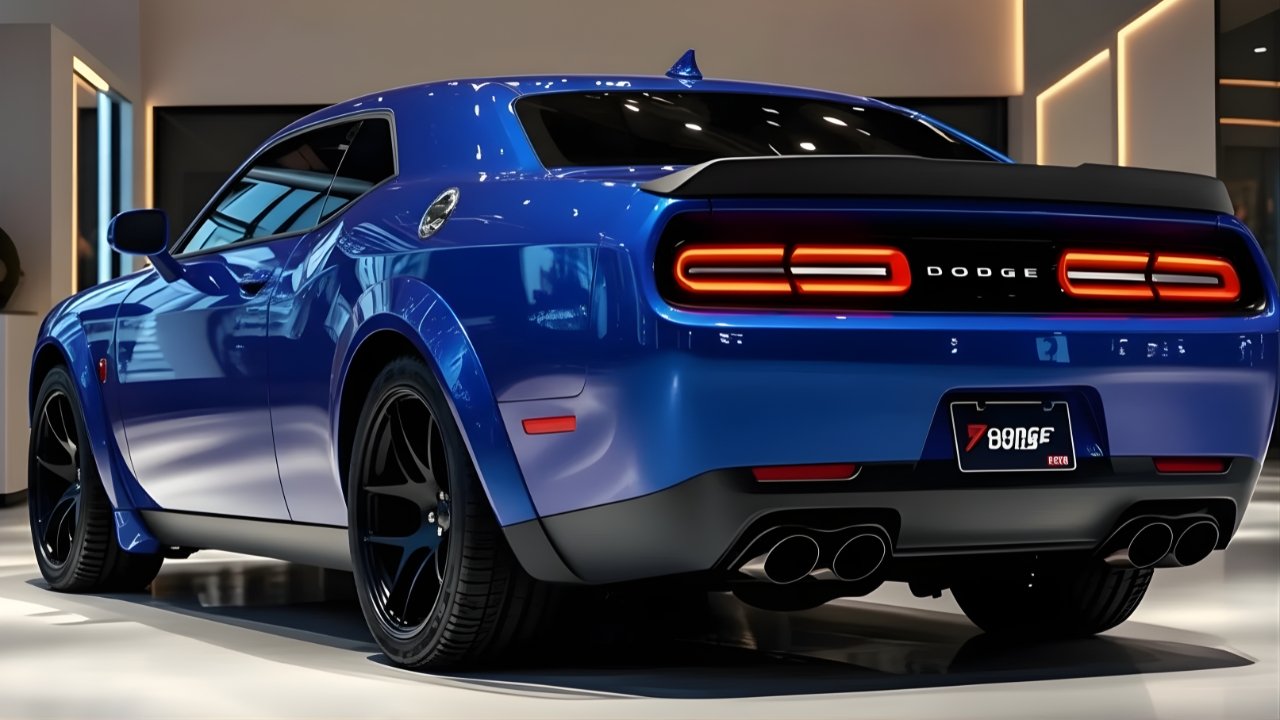
The 2026 Dodge Challenger arrives at a moment when American muscle is being rethought for a new era, and the 2026 Dodge Challenger seeks to blend show-stopping straight-line ability with modern efficiency and technology so that customers can enjoy raw presence without surrendering everyday usability.
The program behind the 2026 Dodge Challenger clearly set out to retain the Challenger’s iconic proportions and aggressive stance while updating aerodynamics, chassis stiffness and electronic controls to suit higher speeds and modern safety expectations.
Reported product strategy suggests Dodge intends the 2026 Dodge Challenger to offer a range of powertrains that balance classic V-8 emotion with new forced-induction and hybrid assist technologies so buyers can choose between visceral character and improved real-world economy.
Early public materials and reputable coverage frame the 2026 Dodge Challenger as a model that honours heritage while preparing the platform for broader global and regulatory realities.
Design: Retro Attitude, Modern Execution
Styling on the 2026 Dodge Challenger emphasises familiar cues—long hood, short rear deck, muscular haunches—while integrating subtle aero improvements and contemporary lighting so the car reads as a modern interpretation rather than a pure reproduction, and these changes help the 2026 Dodge Challenger improve stability at speed without losing the memorable presence that owners expect.
The face is typically wider and lower with a reworked grille and slimmer LED headlamp signatures, and the rear adopts a cleaner light bar treatment and more integrated spoiler so lift is managed more effectively at sustained motorway speeds.
Body-in-white stiffness and panel fit were priorities to reduce flutter and wind noise, and serviceable lower cladding and replaceable impact areas reflect an engineering brief that valued real-world durability in addition to show car polish.
Powertrain Strategy: Heritage Meets Hybrid Assist
Under the hood the 2026 Dodge Challenger offers a layered powertrain strategy: spectral V-8 options for traditionalists, recalibrated high-efficiency turbocharged sixes in the middle of the range, and hybrid-assisted variants on flagship models designed to boost low-end torque and improve transient throttle response while trimming emissions.
Dodge’s broader 2026 lineup shows a clear movement toward downsized, highly boosted engines such as the SIXPACK twin-turbo units and sophisticated thermal systems that keep performance repeatable; the 2026 Dodge Challenger inherits that lesson by emphasising torque delivery, gearbox durability and cooling upgrades so the car can be driven hard without performance fade.
Where electrified assist appears it is tuned to preserve acoustic and mechanical character while providing immediate torque fill, making certain 2026 Dodge Challenger trims feel even more urgent from corner exit. These choices give buyers the option of pure, unfiltered V-8 emotion or a hybridised performance that marries drama with modern on-road efficiency.
Chassis and Dynamics: Usable Power, Repeatable Limits
The 2026 Dodge Challenger’s chassis work focused on delivering repeatable results: reinforced subframes, improved load paths and tuned suspension geometry let the car carry wider tyres and more advanced dampers without losing the planted feel classic to the model, and engineers paid special attention to brake cooling and thermal circuits to maintain pedal feel during repeated high-speed stops.
Adaptive dampers, selectable drive modes and torque-vectoring algorithms allow the 2026 Dodge Challenger to present a civilized face for daily driving while unlocking sharply communicative behaviour on track or B-road runs.
Steering calibration provides a clearer on-centre feel than earlier generations so drivers sense front-end grip early, and electronic aids are designed to broaden the usable limit rather than to blunt driver input—meaning the 2026 Dodge Challenger rewards progressive skill development rather than masking mistakes.
Practical items such as factory-fitted tow anchors, reinforced hitch points and undertray protection are included on certain packages so the car can be used in varied conditions without compromising the engineering.
Interior, Comfort and Tech: Muscle with Modern Manners
Inside the 2026 Dodge Challenger the cabin balances raw intent and daily civility: deeply bolstered seats are offered alongside heated and ventilated comfort choices, and the dash houses a configurable digital cluster that can show classic analogue themes or full telemetry when the driver wants to dig into lap data.
Infotainment and connectivity align with modern expectations—large portrait-oriented screens, over-the-air updates for maps and drive software and integrated telematics that provide predictive maintenance alerts—so owners benefit from convenience features without diluting the car’s focus.
NVH treatments and acoustic glazing are improved to let the engine’s tone come through with clarity while keeping wind and road noise from tiring occupants, and storage solutions have been made more practical so the 2026 Dodge Challenger can be used for weekend trips as comfortably as it can for weekend blasts.
Safety and driver assistance packages are available to match regional regulations and buyer preference, giving the 2026 Dodge Challenger broader appeal beyond pure-enthusiast circles.
Real-World Performance and Ownership Considerations
Early drives and independent analysis of sibling models indicate that the 2026 Dodge Challenger can deliver strong straight-line numbers while also being more tractable in traffic than older, less refined muscle cars; thoughtful gear ratios, available mild-hybrid systems and improved thermal regimes mean the 2026 Dodge Challenger is less likely to suffer performance fade under repeated high-load use.
Ownership economics are shaped by spec choices—higher-output variants typically have increased service and fuel costs—so prospective buyers should consider intended use and local support networks when choosing a trim.
Dealer and factory service programmes for the 2026 Dodge Challenger emphasise performance-oriented maintenance packages and optional performance training days to help owners exploit the car safely; historically these programs improve owner satisfaction and preserve residuals for well-maintained examples.
For buyers who value authenticity, the V-8 variants remain the emotional core of the 2026 Dodge Challenger lineup, while hybrid-assisted versions offer a compelling compromise for those who want modern efficiency without surrendering the model’s identity.
Conclusion
The 2026 Dodge Challenger represents a carefully calibrated attempt to carry American muscle into a new regulatory and technological era, and the 2026 Dodge Challenger balances signature presence with engineering updates that make the car more usable, repeatable and broadly appealing than some of its predecessors.
Whether buyers prioritise a thunderous V-8, a high-output turbocharged middle ground, or a hybrid-assisted flagship, the 2026 Dodge Challenger platform is designed to provide a cohesive experience: dramatic on the headline stats, refined in daily use and supported by factory programmes that help owners get the most from their cars.
Prospective purchasers should test representative trims back-to-back, verify local servicing and parts support for the 2026 Dodge Challenger configuration they choose, and ask about factory performance servicing and owner training if they plan to exercise the car on track—those steps will ensure the car performs as promised and retains value over time.
Disclaimer:
This article is informational, synthesises manufacturer communications and independent coverage, and reflects likely engineering directions and ownership considerations; readers should verify the exact specifications, options, pricing and regional availability of the 2026 Dodge Challenger with authorised Dodge/Stellantis sources or local dealers before making any purchase decision.
