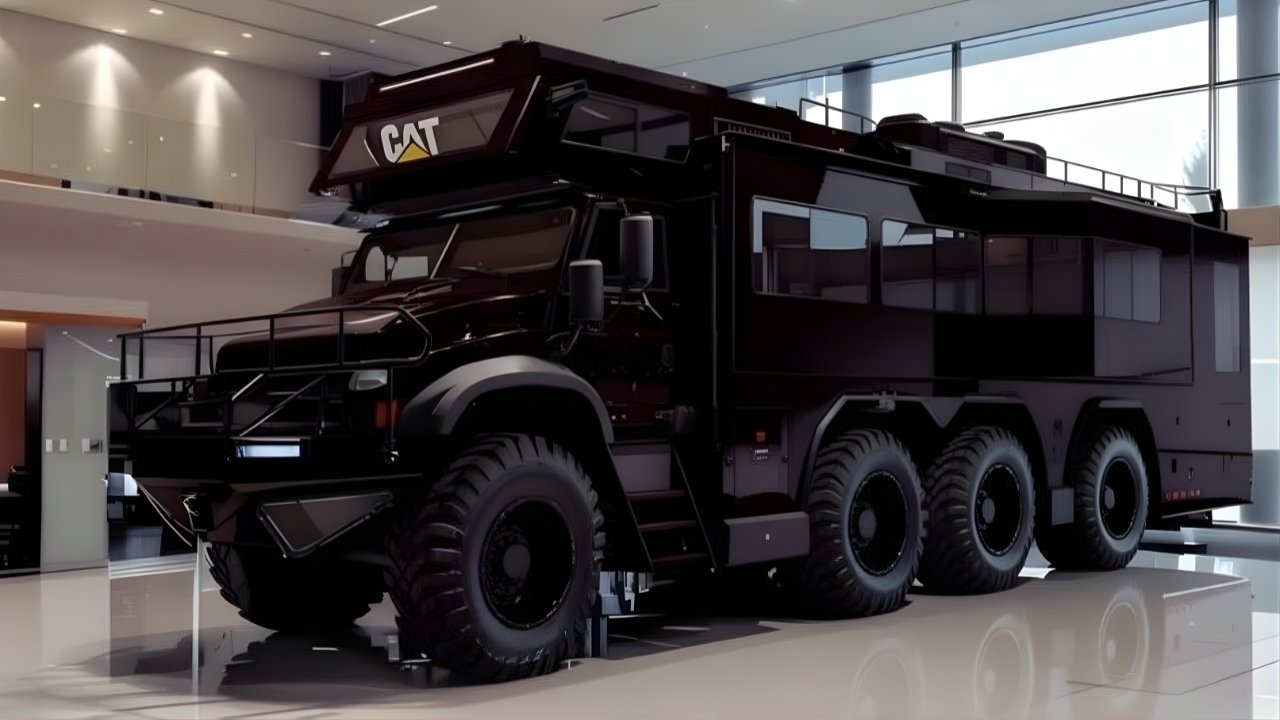
The reveal of the 2026 Caterpillar Motorhome signals a new chapter where heavy-duty utility meets curated luxury, a vehicle designed for owners who expect true expedition capability without sacrificing living comfort. Unlike run-of-the-mill RVs built primarily for roads paved and campgrounds, the 2026 Caterpillar Motorhome is engineered from the ground up to traverse remote tracks, cross soft sand and carry serious payload while offering a residential interior that can sustain long expeditions.
Buyers 2026 Caterpillar Motorhome who have spent years adding aftermarket protection and accessories to commercial RV platforms will immediately recognise the value proposition here: factory-grade drivetrain robustness, bespoke heavy-duty chassis systems, and an interior architecture optimised for extended off-grid living.
In short, this motorhome is for explorers who demand that every system—mechanical, electrical and functional—be sized, rated and tested to match the ambition of worldwide travel, and it answers a growing market for adventure vehicles that blend real capability with modern on-board comfort.
Design and Chassis Engineering
The DNA of the 2026 Caterpillar Motorhome begins with a purpose-built chassis that borrows lessons from heavy equipment and expedition vehicle engineering rather than simply adapting a commercial van platform. Key structural elements—ladder-frame reinforcement, boxed perimeter rails and modular crossmembers—deliver the torsional rigidity needed for large overhangs, rooftop systems and integrated tanks, while isolating the living module from road shocks.
The 2026 Caterpillar Motorhome suspension architecture is a hybrid design marrying long-travel coil springs or progressive helper air springs with heavy-duty dampers and multi-link control arms to maintain wheel articulation and ride composure across varied terrain. Ground clearance is generous but intelligently packaged so approach and departure angles remain useable for real trails. Underbody protection is not an afterthought: deep-drawn skid plates, reinforced diff covers and segmented bash guards protect vulnerable components and are serviceable without removing the entire armor.
The 2026 Caterpillar Motorhome therefore approaches off-road resilience as a core requirement rather than a bolt-on option, producing a platform that can both carry heavy payloads and withstand repeated exposure to harsh conditions without early fatigue.
Powertrain, Drive Systems and Range
Power and redundancy are central to the motorhome’s operational philosophy. The driveline options emphasise torquey diesel engines and purpose-built hybrid systems calibrated for low-end pulling force, towing and long sustained climbs.
Heavy-duty cooling packages, oversized charge air systems and robust transmissions with conservative thermal tolerances ensure performance under load and at altitude. For true expedition utility the 2026 Caterpillar Motorhome offers dual-fuel or multi-tank options in selected markets, plus factory-integrated generator systems that work symbiotically with the main engine to recharge house batteries while stationary.
All-wheel-drive configurations include locked differentials, off-road tune bundles and selectable low-range gearing so drivers can confidently traverse steep, rutted tracks or traverse loose surfaces at controlled speeds. When combined with large, modular fuel tanks and efficient cruise calibration for highway travel, the result is a vehicle whose real-world range and towing stability make distant, low-infrastructure travel practical rather than a gamble.
Interior Layout and Live-aboard Comfort
What sets the 2026 Caterpillar Motorhome apart from many expedition rigs is how the living space is conceived as a true extension of the mechanical platform: mass is distributed to preserve centre of gravity, storage bays are integrated into the chassis architecture, and water, waste and power systems are routed for both durability and serviceability.
Inside, the layout favours a lounge and galley designed for extended use—full-size appliances where possible, deep pantry capacity and integrated work surfaces that double as mobile offices. Sleeping arrangements optimise climate control and insulation, using multi-layer cabin walls and acoustic foams to reduce external noise while improving thermal retention in cold environments.
Sanitation systems are engineered for remote use with macerators and easy-access service panels, and water systems include high-capacity filtration and UV sanitisation options to reduce reliance on uncertain supply points. Crucially, the interior materials are chosen for wear resistance and reparability: replaceable upholstery panels, modular cabinetry and tool-accessible mounting points mean owners can service or adapt the space without specialised factory tools.
The 2026 Caterpillar Motorhome’s living area therefore behaves like a resilient microhome engineered for long itineraries rather than a temporary hotel on wheels.
Energy, Electronics and Off-Grid Systems
A modern expedition motorhome must be an energy system as much as a vehicle, and the 2026 Caterpillar Motorhome integrates layered power sources to maximise autonomy. Solar arrays are roof-mounted on low-profile frames with microinverters or high-voltage MPPT controllers, supplementary portable panels are stowable for flexible charging, and a scalable battery bank—built from lithium chemistry with cell balancing and thermal management—is standard in higher trims.
The on-board inverter/charger architecture supports combined AC and DC loads with smart prioritisation so critical systems (water pumps, refrigeration and comms) remain online during limited input conditions. Charging logic is intelligent: when the engine runs it can feed high-power charge to the house bank up to safe thresholds, while shore and generator inputs are coordinated through an automatic transfer switch to avoid overloading any single source.
For serious operators the vehicle offers redundant inverters, emergency jump-start circuits and isolated bus bars for sensitive electronics, plus a sophisticated monitoring app that provides real-time diagnostics and remote alerts—features that materially reduce the logistical complexity of long off-grid expeditions.
Capability, Storage and Expedition Accessories
The practicalities of expedition life are solved through purpose-built storage and payload management systems that the 2026 Caterpillar Motorhome standardises rather than makes optional. External lockers are arranged to accept heavy gear—rotor blades, recovery kits, spare fuel, dedicated tool cabinets—and are fitted with locking, ventilated mounts and electrical pass-throughs for powered winches or pumps.
Roof and rear mounting systems accept modular payloads from satellite dishes to rooftop tents, while integrated air compressors and on-board water recovery tools allow owners to manage tyre pressures and water supplies without additional equipment. Underfloor storage makes use of previously wasted volumes, and the motorhome’s payload budget is communicated transparently so buyers can equip the vehicle without risking overload.
Safety and recovery are designed-in: high-capacity winches, quick-mount recovery points and skid-resistant step systems are built to OEM tolerances for long life, and factory training packages accompany vehicle deliveries to ensure owners know the right recovery and towing practices for heavy rigs in remote terrain.
Technology, Safety and Communications
Connectivity and safety systems on the 2026 Caterpillar Motorhome aim to keep crews connected, informed and secure even when miles from conventional networks.
Dual-SIM 4G/5G routers, satellite comms packages and mesh-network repeaters allow teams to maintain telemetry and voice data across wide areas. Autonomous safety features are calibrated for heavy vehicles: trailer-aware stability control, advanced ABS tuning for high-mass braking profiles, automatic load-sway mitigation and thermal monitoring for drivetrain components reduce the risk of mechanical issues in severe use.
Driver aids include terrain-adaptive traction control, hill-start and descent aids specifically tuned to loaded rigs, and a comprehensive camera suite that provides 360-degree visibility for tight manoeuvres and campsite setups.
Emergency management tools—auto-deployable beacons, integrated first-aid storage and redundant lighting—support rescue scenarios and coordinated multi-vehicle expeditions. The technology package therefore transitions the vehicle from a transport platform into an operational hub for extended fieldwork and exploration.
Ownership, Serviceability and Long-Term Value
Buying an expedition motorhome is a long-term commitment and the 2026 Caterpillar Motorhome addresses ownership realities through modular serviceability and a commercial-grade parts philosophy. Major systems—suspension modules, electrical packs and drivetrain components—are accessible through service panels and designed to be replaced without specialized frame alterations.
Caterpillar’s service network and authorised conversion partners offer extended warranty options and certified training for local mechanics, which is vital in reducing downtime during global expeditions. The motorhome also includes a detailed maintenance scheduling system and pre-delivery owner instruction that covers routine checks and field repairs.
From a resale perspective, the vehicle’s OEM integration of heavy-duty hardware and documented service history typically preserves value better than heavily modified aftermarket conversions because the systems were engineered and tested as unified assemblies rather than disparate add-ons. These ownership supports position the 2026 Caterpillar Motorhome as an investment in capability rather than a temporary novelty.
Conclusion
The 2026 Caterpillar Motorhome is a considered synthesis of heavy-duty engineering and human-centred living design: it is at once a voyager’s vehicle and a rugged mobile base camp, capable of carrying people, equipment and comforts into places conventional RVs cannot safely or reliably go.
By standardising robust chassis systems, layered power architectures, expedition-grade storage and comprehensive safety and communications suites, this motorhome reduces the unknowns that typically accompany long-distance, off-grid travel. Owners who require both real capability and a true live-aboard environment will find in this vehicle a platform that respects the practical demands of exploration while delivering a homey interior for rest and work.
Prospective buyers should carefully match their intended mission profiles to the vehicle’s configuration—engine choice, auxiliary power systems, payload and accessory packages—and budget for authorised training and a certified service plan to maximise both safety and long-term value.
Disclaimer:
this article summarises the product positioning, engineered systems and ownership considerations for the 2026 Caterpillar Motorhome based on manufacturer briefs and industry reporting; verify final specifications, optional equipment packages, pricing and service commitments with authorised Caterpillar dealers or official sources before purchase.
